
The research, led by the University of Leipzig, involved the Curt-Engelhorn Centre for Archaeometry (CEZA) in Mannheim, which contributed in particular OSL and radiocarbon (¹⁴C) dating as part of the interdisciplinary project.
The study demonstrates that extreme, high-energy flood events in the Ahr Valley have occurred at least four times over the past 1,500 years. In addition to the catastrophic flood of 2021, the historical extreme floods of 1804 and 1910, as well as a previously unknown event dating to the late 5th century AD, were identified. The sedimentary archive of the Ahr floodplain records exclusively very high-magnitude flood events, while deposits from low- to medium-intensity floods are absent or not yet recognized. These findings highlight the strong potential of floodplain sediments for reconstructing extreme flood events and at the same time reveal the limitations of hazard assessments based on instrumental records.
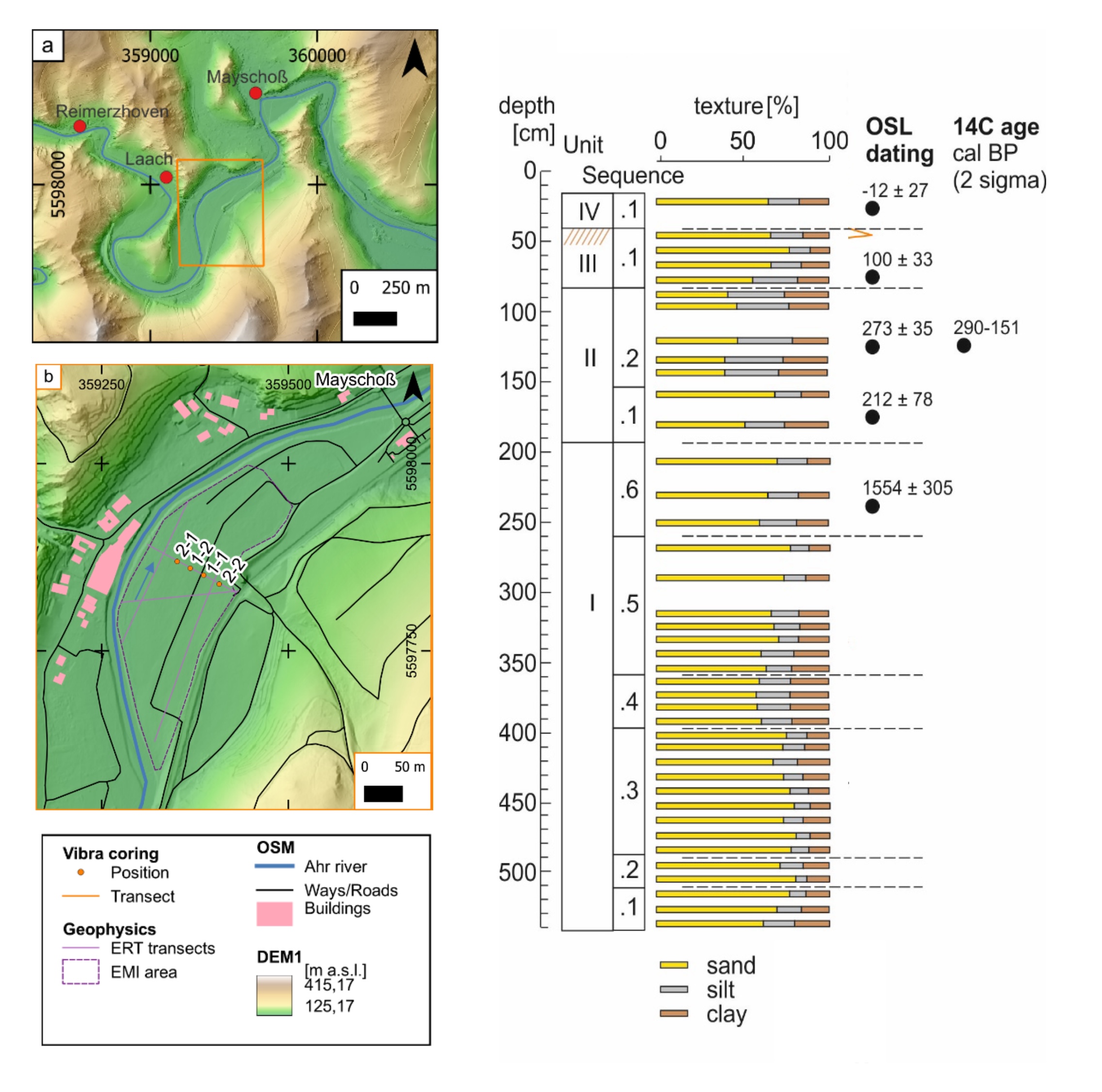
Within the project, CEZA Mannheim was responsible for the luminescence- and radiocarbon-based age determination of the fluvial sediments. Several samples from a sediment core up to 5.5 m long were analysed in the CEZA OSL laboratory, and dose rates were determined using gamma spectrometry. For CEZA, this posed a good and successful opportunity for a methodological test regarding the zeroing of the luminescence signal of the sediments during the latest flooding event. For one of the historical flood events, the OSL-derived ages could be confirmed by an additional radiocarbon (¹⁴C) dating of organic material. Other ¹⁴C measurements pointed to redeposition of the material during the respective flooding event. By combining both dating methods, CEZA made a relevant contribution to the chronological framework of the flood events and to the validation of the sedimentological interpretations.
The full article in Earth Surface Processes and Landforms finden Sie hier.